

Yoga can be a safe and effective form of exercise for older adults when practised with the right techniques and modifications. Gentle styles such as Chair Yoga, Hatha Yoga, and Restorative Yoga are often recommended for seniors because they improve mobility, balance, and flexibility.
As people age, concerns such as reduced flexibility, joint stiffness, balance issues, and chronic health conditions can make some forms of exercise challenging. This is why physiotherapists and geriatric wellness experts often suggest low-impact yoga practices that can be adapted to different mobility levels and physical abilities. Many senior living communities, including our old age home in Navi Mumbai, build these sessions into residents’ daily routines.
In this blog, you will learn the best types of yoga for older people, important safety precautions, beginner-friendly poses, breathing exercises, and a simple daily routine that can help support healthy and independent ageing.
Why Yoga Is Important for Old People
Yoga improves mobility, balance, flexibility, breathing, and emotional health without putting excessive stress on joints. Unlike high-impact workouts, yoga can be adapted to different fitness levels, making it suitable for many seniors.
As people age, the body naturally undergoes several changes that can affect daily life. One of the most common is sarcopenia, the gradual loss of muscle mass and strength that occurs with ageing. Older adults may also experience reduced flexibility, joint stiffness, slower reflexes, and a decline in balance and coordination.
Top Benefits of Yoga for Elderly Individuals
Regular yoga practice can support balance, mobility, strength, cardiovascular health, sleep quality, and mental well-being.
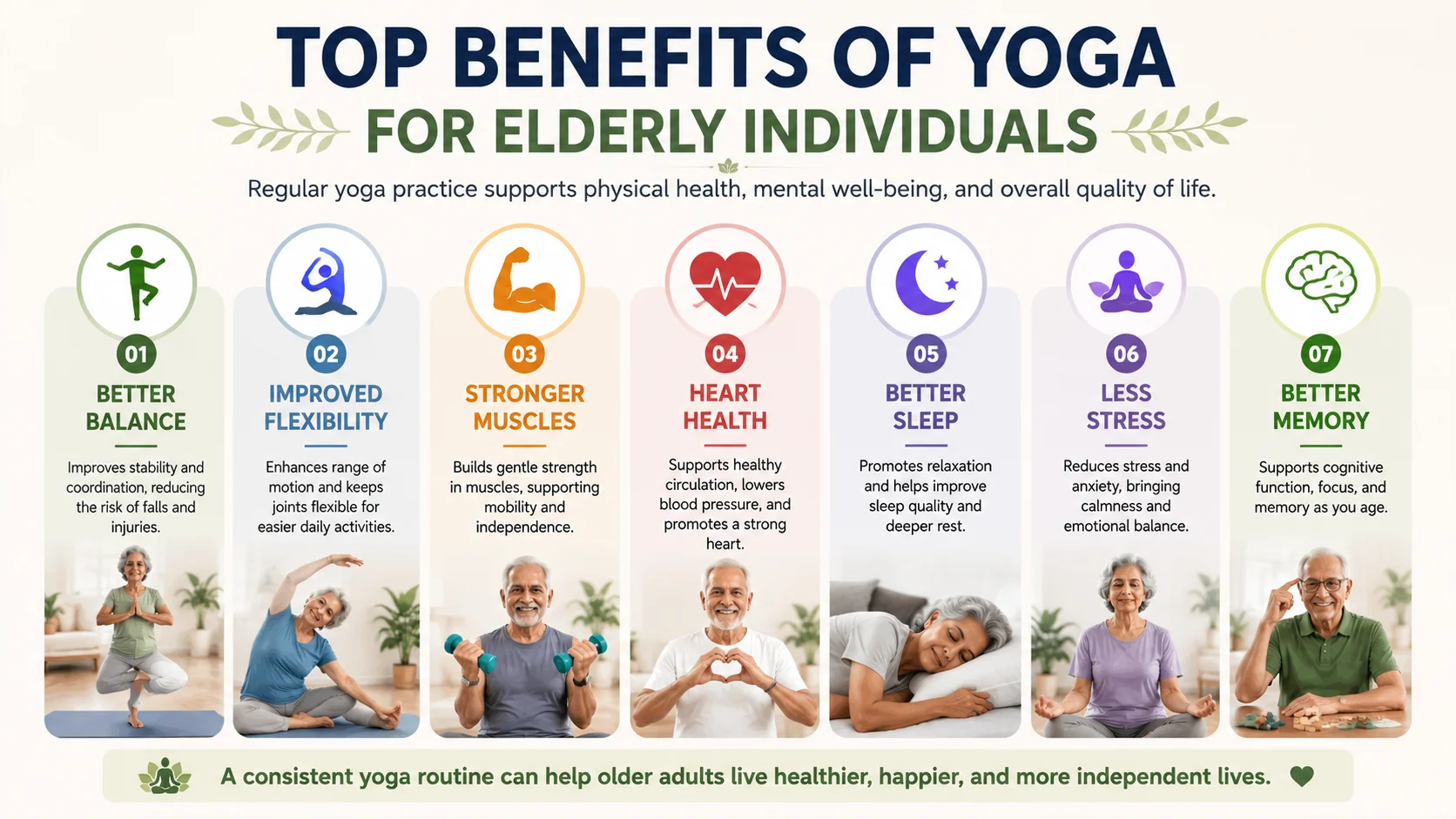
Improves Balance and Prevents Falls
Yoga helps older adults improve balance, coordination, and body awareness, reducing the risk of falls and fall-related injuries. This is particularly important because falls are among the leading causes of injury and hospitalisation in seniors.
What Research Says: Studies have found that balance-focused yoga programs can improve stability and lower-body strength in older adults.
Increases Flexibility and Joint Mobility
Yoga gently stretches muscles and joints, helping seniors maintain flexibility and range of motion. This can reduce stiffness and make everyday movements more comfortable.
What Research Says: Gentle stretching exercises have been shown to improve joint mobility and physical function in older adults.
Builds Strength Without High Impact
Yoga strengthens muscles using controlled bodyweight movements rather than high-impact exercises. This makes it a safer option for many seniors.
Supports Heart Health
Yoga supports cardiovascular health by encouraging movement, relaxation, and healthy breathing patterns.
Improves Sleep Quality
Many seniors experience sleep disturbances due to stress, discomfort, or age-related changes in sleep patterns. Yoga may help promote more restful sleep.
Reduces Stress and Anxiety
Yoga combines movement, breath control, and mindfulness practices that can help reduce stress and anxiety levels.
Improves Memory and Cognitive Function
Yoga may support brain health by combining physical movement with focused breathing and mindfulness practices.
Benefits of Yoga for Older Adults With Common Health Conditions
Yoga may help seniors manage several age-related health concerns. Below are the yoga practices:

Yoga for Arthritis
Yoga can help older adults with arthritis maintain joint mobility, reduce stiffness, and improve overall physical function. Gentle stretching and controlled movements encourage circulation around the joints, which may help them feel less rigid and more comfortable throughout the day.
How It Helps:
- Promotes joint lubrication through regular movement
- Reduces stiffness and discomfort
- Improves flexibility and range of motion
- Supports easier performance of daily activities
Expert Note: Seniors with arthritis should consult a doctor or physiotherapist before attempting weight-bearing poses and should avoid movements that cause pain.
Yoga for Osteoporosis
Yoga can be beneficial for seniors with osteoporosis when performed with appropriate modifications. Certain gentle, weight-bearing movements may help support muscle strength, posture, and bone health without placing excessive stress on the body.
How It Helps:
- Encourages gentle strength building
- Supports better posture and balance
- May help reduce fall risk
- Promotes bone-supportive movement patterns
Safety Tip: Avoid deep forward bends, forceful twists, or high-impact movements unless specifically approved by a healthcare professional.
Yoga for High Blood Pressure
Yoga may help manage high blood pressure by encouraging relaxation, reducing stress, and improving breathing patterns. Slow-paced yoga styles are often preferred because they place less strain on the cardiovascular system.
How It Helps:
- Supports stress reduction
- Encourages mindful breathing
- Promotes relaxation of the nervous system
- May contribute to healthier blood pressure levels when combined with medical care
Recommended Practices: Deep breathing exercises, Chair Yoga, Restorative Yoga, and relaxation poses such as Legs-Up-the-Wall.
Yoga for Diabetes
Regular yoga practice can help older adults with diabetes stay physically active while supporting overall wellness. Movement and stress management are both important components of diabetes care.
How It Helps:
- Encourages regular physical activity
- Supports healthy weight management
- Helps reduce stress levels
- Promotes better overall well-being
Practical Example: A simple daily yoga routine that includes stretching, walking, and breathing exercises can help seniors remain active and maintain healthy lifestyle habits.
Yoga for Back Pain
Back pain is a common concern among older adults, often caused by poor posture, muscle weakness, or reduced flexibility. Yoga can help strengthen supporting muscles while improving movement and alignment.
How It Helps:
- Improves posture and spinal alignment
- Strengthens core and back muscles
- Reduces muscle tension
- Increases flexibility and mobility
Best Options for Seniors: Gentle seated stretches, Cat-Cow movements, Chair Yoga, and beginner-friendly core-strengthening exercises performed under guidance.
Important Reminder: Seniors with chronic medical conditions should speak with their healthcare provider before starting a new yoga program. A qualified yoga instructor or physiotherapist can help modify poses to match individual health needs and mobility levels.
Best Types of Yoga for Seniors
The best yoga styles for seniors include Chair Yoga, Hatha Yoga, Restorative Yoga, and Gentle Yoga because they are easy to modify, beginner-friendly, and place less stress on joints.
Chair Yoga
Chair Yoga is one of the safest and most accessible forms of yoga for seniors with limited mobility, balance concerns, or difficulty standing for long periods. The poses are performed while sitting on a chair or using a chair for support, reducing the risk of falls while still providing the benefits of stretching and movement.
Best For:
- Seniors with mobility limitations
- Individuals recovering from illness or injury
- Older adults who need extra balance support
Key Benefits:
- Improves flexibility and circulation
- Enhances balance and coordination
- Reduces joint strain
- Increases confidence in movement
Hatha Yoga
Hatha Yoga is a traditional yoga style that emphasises slow-paced movements, basic poses, and controlled breathing. Because of its gentle approach, it is often recommended for older adults who are new to yoga.
Best For:
- Beginners
- Active seniors looking to improve flexibility
- Older adults seeking a structured yoga practice
Key Benefits:
- Improves posture and balance
- Builds strength gradually
- Encourages mindful breathing
- Enhances body awareness
Restorative Yoga
Restorative Yoga focuses on relaxation and recovery through supported poses held for longer periods. Props such as cushions, blankets, and bolsters are often used to maximise comfort and reduce physical effort.
Best For:
- Seniors experiencing stress or fatigue
- Individuals with chronic pain
- Older adults seeking relaxation and recovery
Key Benefits:
- Promotes deep relaxation
- Helps reduce stress and anxiety
- Encourages better sleep quality
- Supports emotional well-being
Gentle Yoga
Gentle Yoga is a beginner-friendly style that combines simple stretches, basic yoga poses, and breathing exercises. The pace is slower than in many traditional yoga classes, making it suitable for older adults who want to improve flexibility and mobility without intense physical demands.
Best For:
- First-time yoga practitioners
- Seniors with mild joint stiffness
- Older adults seeking a low-impact exercise routine
Key Benefits:
- Improves flexibility and mobility
- Reduces muscle tension
- Supports healthy ageing
- Builds confidence for progressing to other yoga styles
10 Best Yoga Poses for Old Age Persons
The best yoga poses for seniors are those that improve flexibility, balance, strength, and mobility while minimising strain on the joints. These beginner-friendly poses can be modified to suit different fitness and mobility levels.
Chair Mountain Pose
Chair Mountain Pose improves posture, body awareness, and sitting balance.
What It Helps With:
- Better posture
- Core engagement
- Sitting balance
How to Perform:
Sit upright in a sturdy chair with both feet flat on the floor. Lengthen your spine, relax your shoulders, and place your hands on your thighs. Take slow, deep breaths while maintaining an upright posture.
Modifications:
Use a chair with armrests for additional support.
Safety Notes:
Avoid arching the lower back or straining the neck.
Chair Cat-Cow Stretch
What It Helps With:
- Spinal mobility
- Back pain relief
- Improved flexibility
How to Perform:
Sit comfortably in a chair. As you inhale, lift your chest and gently arch your back (Cow Pose). As you exhale, round your spine and tuck your chin toward your chest (Cat Pose). Repeat slowly.
Modifications:
Reduce the range of motion if movement causes discomfort.
Safety Notes:
Move slowly and avoid forcing the spine into deep stretches.
Seated Forward Bend
What It Helps With:
- Hamstring flexibility
- Lower back mobility
- Relaxation
How to Perform:
Sit on a chair with your feet hip-width apart. Gently hinge forward from the hips while keeping your back comfortable and relaxed.
Modifications:
Place your hands on your thighs for support.
Safety Notes:
Avoid deep bending if you have severe osteoporosis or back issues.
Seated Spinal Twist
What It Helps With:
- Spinal mobility
- Improved posture
- Gentle stretching
How to Perform:
Sit upright and slowly rotate your torso to one side while keeping your hips facing forward. Hold briefly and repeat on the other side.
Modifications:
Perform a smaller twist if flexibility is limited.
Safety Notes:
Avoid forceful twisting movements.
Tree Pose With Support
What It Helps With:
- Balance
- Coordination
- Leg strength
How to Perform:
Stand beside a wall or chair. Place one foot lightly against the opposite ankle or calf while maintaining balance. Hold for several breaths and switch sides.
Modifications:
Keep toes on the floor for extra stability.
Safety Notes:
Always use support if balance is a concern.
Supported Warrior Pose
What It Helps With:
- Leg strength
- Stability
- Posture
How to Perform:
Stand with one foot forward and one foot back while holding onto a chair or wall for support. Bend the front knee slightly and maintain an upright posture.
Modifications:
Shorten your stance to reduce strain.
Safety Notes:
Avoid overextending the knees.
Standing Side Stretch
What It Helps With:
- Flexibility
- Rib cage mobility
- Posture
How to Perform:
Stand comfortably and raise one arm overhead. Gently lean to the opposite side and hold for a few breaths before switching sides.
Modifications:
Perform while seated if standing is difficult.
Safety Notes:
Avoid sudden movements.
Supported Bridge Pose
What It Helps With:
- Core strength
- Hip mobility
- Lower back support
How to Perform:
Lie on your back with knees bent and feet flat on the floor. Lift your hips slightly and hold briefly before lowering.
Modifications:
Place a cushion under the hips for support.
Safety Notes:
Avoid if lying on your back causes dizziness.
Legs-Up-The-Wall Pose
What It Helps With:
- Relaxation
- Reduced leg fatigue
- Improved circulation
How to Perform:
Sit beside a wall and gently swing your legs upward while lying on your back. Rest comfortably with your legs supported by the wall.
Modifications:
Place a folded blanket under the hips for comfort.
Safety Notes:
Avoid if advised against inversion-style positions by your healthcare provider.
Corpse Pose (Savasana)
What It Helps With:
- Stress reduction
- Relaxation
- Mindfulness
How to Perform:
Lie comfortably on your back with your arms resting by your sides. Focus on slow, natural breathing and relax your entire body.
Modifications:
Place cushions under the knees or head for support.
Safety Notes:
Use a side-lying position if lying flat is uncomfortable.
Best Breathing Exercises for Seniors
Breathing exercises like pranayama help improve lung function, reduce stress, support relaxation, and promote better focus.
Deep Belly Breathing
Deep Belly Breathing, also known as diaphragmatic breathing, encourages full oxygen exchange and helps activate the body’s relaxation response.
Benefits:
- Promotes relaxation and stress reduction
- Improves breathing efficiency
- Supports better oxygen flow throughout the body
- May help lower feelings of anxiety
Instructions:
- Sit comfortably in a chair or lie down in a relaxed position.
- Place one hand on your chest and the other on your abdomen.
- Inhale slowly through your nose, allowing your belly to rise.
- Exhale gently through your mouth or nose.
- Repeat for 5–10 breaths.
Who Should Avoid:
Most seniors can safely practice Deep Belly Breathing. However, individuals with severe respiratory conditions should consult their healthcare provider if breathing exercises cause discomfort.
Alternate Nostril Breathing
Alternate Nostril Breathing is a calming yoga breathing technique that involves breathing through one nostril at a time in a controlled pattern.
Benefits:
- Encourages mental focus and concentration
- Helps reduce stress and nervous tension
- Promotes a sense of calm and balance
- Supports mindful breathing habits
Instructions:
- Sit comfortably with your spine upright.
- Use your right thumb to gently close your right nostril.
- Inhale slowly through the left nostril.
- Close the left nostril with your finger and release the right nostril.
- Exhale through the right nostril.
- Inhale through the right nostril and repeat the pattern.
- Continue for 1–3 minutes.
Who Should Avoid:
Seniors experiencing severe nasal congestion, breathing difficulties, or dizziness should avoid this technique until symptoms improve.
4-4-6 Relaxation Breathing
The 4-4-6 method is a simple breathing exercise that encourages relaxation by slowing the breathing rate and calming the nervous system.
Benefits:
- Helps reduce stress and anxiety
- Encourages relaxation before sleep
- Promotes emotional well-being
- Supports mindful breathing practices
Instructions:
- Sit or lie in a comfortable position.
- Inhale gently through your nose for a count of 4.
- Hold your breath for a count of 4.
- Exhale slowly through your mouth for a count of 6.
- Repeat the cycle for 3–5 minutes.
Who Should Avoid:
Individuals with respiratory conditions who find breath-holding uncomfortable should shorten or skip the hold phase and consult a healthcare professional if needed.
Which Breathing Exercise Is Best for Seniors?
Deep Belly Breathing is often the best starting point for seniors because it is simple, gentle, and easy to learn. Those looking to improve relaxation and focus may benefit from Alternate Nostril Breathing, while 4-4-6 Relaxation Breathing can be particularly helpful for managing stress and preparing for restful sleep.
Chair Yoga vs Traditional Yoga for Seniors
Chair Yoga provides additional support and stability, while Traditional Yoga allows for a wider range of movements and poses.
| Feature | Chair Yoga | Traditional Yoga |
| Balance Support | High – Uses a chair for stability and support | Moderate – Requires independent balance during many poses |
| Joint Pressure | Low – Gentle on knees, hips, and ankles | Moderate – Some poses place more weight on joints |
| Beginner Friendly | Excellent – Suitable for most fitness and mobility levels | Good – May require modifications for beginners |
| Fall Risk | Low – Chair provides added safety and confidence | Moderate – Standing poses may increase fall risk for some seniors |
| Mobility Requirements | Minimal – Can be performed while seated | Moderate – Requires standing and floor-based movements |
| Best For | Seniors with limited mobility, arthritis, or balance concerns | Active seniors seeking greater flexibility and strength |
| Equipment Needed | Sturdy chair | Yoga mat and open space |
| Pose Modifications | Easy to adapt for physical limitations | May require props or instructor guidance |
15-Minute Daily Yoga Routine for Elderly Beginners
Seniors can start yoga with a simple 15-minute routine that focuses on mobility, flexibility, balance, and relaxation.
Warm-Up (3 Minutes)
Begin with gentle movements to prepare the muscles and joints for exercise.
Suggested Activities:
- Shoulder rolls (30 seconds)
- Neck stretches (30 seconds)
- Ankle circles (30 seconds per side)
- Wrist rotations (30 seconds)
- Deep breathing (1 minute)
Purpose:
- Increases circulation
- Reduces stiffness
- Prepares joints for movement
Gentle Poses (5 Minutes)
Perform beginner-friendly yoga poses slowly and comfortably.
Recommended Poses:
- Chair Mountain Pose (1 minute)
- Chair Cat-Cow Stretch (1 minute)
- Seated Forward Bend (1 minute)
- Seated Spinal Twist (1 minute)
- Standing Side Stretch (1 minute)
Purpose:
- Improves flexibility
- Enhances posture
- Supports joint mobility
Balance Exercises (3 Minutes)
Balance training can help reduce fall risk and improve confidence during daily activities.
Recommended Exercises:
- Tree Pose with Support (1 minute per side)
- Supported Heel Raises (1 minute)
Purpose:
- Improves stability
- Strengthens lower-body muscles
- Enhances coordination
Safety Tip: Always practice near a wall, chair, or sturdy support if balance is a concern.
Breathing Practice (4 Minutes)
Finish the routine with calming breathing exercises to encourage relaxation and mindfulness.
Recommended Exercises:
- Deep Belly Breathing (2 minutes)
- 4-4-6 Relaxation Breathing (2 minutes)
Purpose:
- Reduces stress and anxiety
- Encourages relaxation
- Supports better sleep quality
Modifications for Different Needs
For Wheelchair Users
Many yoga exercises can be performed while seated. Chair Mountain Pose, Chair Cat-Cow Stretch, Seated Spinal Twist, arm stretches, and breathing exercises are excellent options for maintaining mobility and flexibility.
For Arthritis Patients
Move slowly and avoid forcing joints into uncomfortable positions. Chair Yoga and Gentle Yoga are often more comfortable than standing or weight-bearing poses. Stop any movement that causes pain.
For Seniors Above 75
Focus on shorter sessions, controlled movements, and additional support when needed. Using a chair, wall, or yoga props can improve safety and confidence while exercising. Seniors in residential care, such as our old age home in Panvel, often have trained staff on hand to guide these sessions safely.
7-Day Beginner Yoga Plan for Seniors
This simple 7-day yoga plan introduces flexibility, balance, strength, mobility, and relaxation gradually, allowing seniors to build confidence without overexertion. Each session can be completed in 10–15 minutes and adjusted based on individual fitness and mobility levels.

Day 1 – Flexibility
Focus on gentle stretches to reduce stiffness and improve range of motion.
Activities:
- Chair Mountain Pose
- Seated Forward Bend
- Standing Side Stretch
- Deep Belly Breathing
Day 2 – Balance
Improve stability and body awareness through simple balance exercises.
Activities:
- Tree Pose with Support
- Supported Heel Raises
- Chair Marching
- Deep Belly Breathing
Day 3 – Breathing
Focus on relaxation and breathing techniques without strenuous movement.
Activities:
- Deep Belly Breathing
- Alternate Nostril Breathing
- 4-4-6 Relaxation Breathing
- Guided Relaxation
Day 4 – Strength
Use gentle yoga poses to support muscle strength and posture.
Activities:
- Supported Warrior Pose
- Chair Squats
- Chair Mountain Pose
- Seated Spinal Twist
Day 5 – Mobility
Encourage smooth joint movement and reduce stiffness.
Activities:
- Chair Cat-Cow Stretch
- Shoulder Rolls
- Ankle Circles
- Standing Side Stretch
Day 6 – Relaxation
Dedicate time to recovery and mental well-being.
Activities:
- Legs-Up-the-Wall Pose
- Gentle Stretching
- Deep Belly Breathing
- Corpse Pose (Savasana)
Day 7 – Full Routine
Combine flexibility, balance, strength, and breathing exercises into one session.
Activities:
- Chair Mountain Pose
- Chair Cat-Cow Stretch
- Tree Pose with Support
- Supported Warrior Pose
- Deep Belly Breathing
- Corpse Pose (Savasana)
Tips for Success
- Start slowly and focus on proper form rather than intensity.
- Use a chair, wall, or yoga props whenever additional support is needed.
- Stay hydrated before and after exercise.
- Stop immediately if you experience pain, dizziness, or discomfort.
- Consult a healthcare professional before starting yoga if you have a chronic medical condition or recent injury.
What Happens After the First Week?
After completing this 7-day plan, seniors can repeat the schedule, increase session duration gradually, or combine their favourite exercises into a personalised routine. The key to experiencing long-term benefits from yoga is consistency rather than intensity.
Yoga Mistakes Older Adults Should Avoid

Holding Your Breath
Breathing steadily during yoga helps deliver oxygen to muscles and promotes relaxation. Holding your breath can increase tension and make movements more difficult.
Skipping Warm-Ups
Starting yoga without warming up may increase the risk of stiffness or injury. Gentle joint movements and stretches prepare the body for exercise.
Overstretching
Yoga should never cause pain. Stretch only to a comfortable range and avoid forcing your body into deeper positions.
Ignoring Pain Signals
Mild stretching sensations are normal, but sharp or persistent pain is not. Stop immediately and modify the pose if discomfort occurs.
Attempting Advanced Poses Too Early
Advanced poses may place unnecessary stress on joints and muscles. Focus on beginner-friendly movements and progress gradually.
Expert Caution: Physiotherapists and yoga instructors recommend listening to your body, using support when needed, and choosing poses that match your mobility and fitness level.
Yoga Poses Seniors Should Avoid
Certain advanced poses such as headstands, unsupported inversions, and deep backbends may increase injury risk for older adults with balance, joint, or mobility limitations. Poses like Headstand, Shoulder Stand, Wheel Pose, and Deep Twists can place excessive stress on the neck, spine, shoulders, and lower back.
Frequently Asked Questions
Is yoga safe for people over 60?
Yes, yoga is generally safe for people over 60 when practised with proper modifications. Gentle styles such as Chair Yoga and Hatha Yoga are often recommended.
Can a 70-year-old start yoga?
Absolutely. Many people begin yoga in their 70s and beyond. Starting with beginner-friendly poses and professional guidance can help ensure safety and comfort.
Which yoga is best for seniors?
Chair Yoga, Hatha Yoga, Restorative Yoga, and Gentle Yoga are among the best options because they are low-impact and easy to modify.
How often should seniors do yoga?
Most seniors can benefit from practising yoga 3–5 times per week for 15–30 minutes, depending on their health, mobility, and fitness level.
Sources & References
To ensure accuracy and credibility, this article is based on widely recognised health and wellness research and guidelines from trusted medical and public health organisations:
- World Health Organisation (WHO) – Falls in Older Age and Prevention Strategies
https://www.who.int/news-room/fact-sheets/detail/falls - National Institutes of Health (NIH) – Yoga for Health: Scientific Research on Benefits of Yoga
https://www.nccih.nih.gov/health/yoga-what-you-need-to-know
