

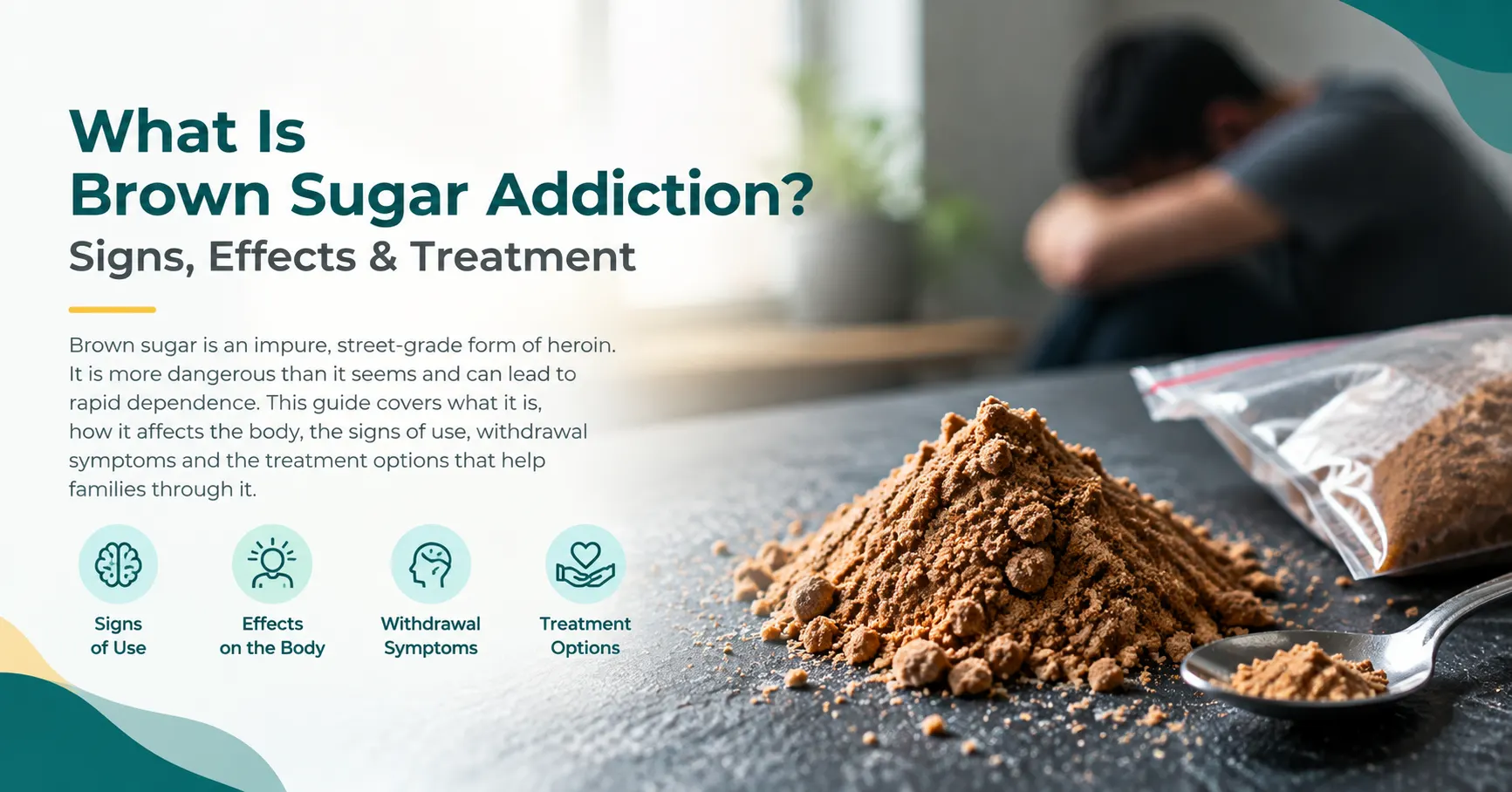
Brown sugar is an impure, street-grade form of heroin. It is typically adulterated with cutting agents during production, often including substances such as caffeine, paracetamol, phenobarbital, and alprazolam, sometimes more than one in a single sample.
Most families underestimate this drug because the name sounds harmless. In reality, this unpredictable mix of heroin and other substances makes brown sugar more dangerous than pharmaceutical-grade heroin, not less. A person can never know exactly how strong a dose is or what else it contains, and that uncertainty raises the risk of overdose with every use.
Regular use can quickly lead to physical dependence. The brain adapts to the drug’s presence, and stopping brings on withdrawal that many people cannot manage without support. This is the core of what doctors classify as opioid use disorder, and it is treatable with the right heroin addiction treatment.
This guide covers how brown sugar affects the body, the signs of use, what withdrawal actually looks like, and the treatment options that help families through it.
What Is Brown Sugar?
Brown sugar is a street name for an impure, illegally made form of heroin. It gets its name from its appearance a coarse, brownish powder that looks nothing like the white crystalline heroin most people picture.
Chemically, it is a semi-synthetic opioid. Manufacturers derive it from morphine, which itself comes from the opium poppy plant, Papaver somniferum. The brown colour and grainy texture come from the impurities mixed into it during production, not from the drug itself.
People and dealers use several other names for the same substance:
Common street names: Smack, Junk, Skag, Dope, Horse, H
The exact name someone uses often depends on the region or the person’s age group, but all of these refer to the same drug and carry the same risks.
Brown Sugar vs Heroin: What’s the Difference

Brown sugar is not a separate drug from heroin. It is heroin, cut with other substances and sold in a cruder, less pure form. The two share the same active ingredient and the same risks, but brown sugar carries additional dangers that pharmaceutical-grade heroin does not.
| Brown Sugar | Refined Heroin | |
|---|---|---|
| Purity | Low and inconsistent, mixed with non-opioid substances during production | Higher and more consistent, though still illegal and dangerous |
| Composition | Heroin combined with cutting agents such as caffeine, paracetamol, phenobarbital, and alprazolam | Closer to pure diacetylmorphine, with fewer added substances |
| Appearance | Coarse, brownish powder | Fine white or off-white powder, though colour varies by source and processing |
| Danger profile | Higher risk of overdose and unpredictable reactions because the exact strength and contents of each dose are unknown | Dangerous and addictive, but the danger comes primarily from the opioid itself rather than unknown fillers |
Because purity and composition vary from batch to batch, no one using brown sugar can know exactly what they are taking. That unpredictability, not just the heroin content itself, is what makes it especially dangerous.
What Is Brown Sugar Made Of?
Brown sugar is never just heroin. Analysis of samples seized in India has identified several substances routinely mixed in, and each one adds its own risk on top of the opioid itself. Here is what some of the most commonly reported cutting agents do:
Caffeine
- What it does: Mimics some of heroin’s effects and helps it vaporise at a lower temperature when smoked.
- Health risk: Can strain the heart and worsen anxiety, especially at higher doses.
Paracetamol (Acetaminophen)
- What it does: Masks heroin’s bitter taste.
- Health risk: Combined with alcohol use, it raises the risk of serious liver damage.
Phenobarbital
- What it does: A barbiturate added as a cheap filler.
- Health risk: Adds to the respiratory depression heroin already causes, increasing overdose risk.
Alprazolam
- What it does: A benzodiazepine, sometimes mixed in to intensify the drug’s effect.
- Health risk: Combining opioids and benzodiazepines significantly increases the risk of fatal respiratory depression, a risk well established in clinical literature.
None of these fillers makes brown sugar “safer” or more diluted in a predictable way. They stack additional risks on top of heroin’s own effects, and no user can know which substances, or how much of each, are in a given dose.
How Is Brown Sugar Used?
People use brown sugar in three main ways: smoking, snorting, or injecting. Each route carries its own risks on top of the drug itself.
- Smoking is the most common method. Users heat the powder and inhale the fumes, sometimes called “chasing the dragon.” Repeated smoking exposes the lungs to heated impurities, raising the risk of respiratory damage over time.
- Snorting involves inhaling the powder through the nose. Repeated use can damage nasal tissue.
- Injecting delivers the drug directly into the bloodstream and carries the highest risk of the three methods. Sharing needles or injection equipment spreads bloodborne infections, including HIV and Hepatitis C.
No method of use is safe. The route only changes which risks are greatest.
Why Does Brown Sugar Become Addictive?
Brown sugar binds to opioid receptors in the brain, the same receptors that normally respond to the body’s own pain-relief chemicals. This flood of activity triggers a surge of dopamine, the brain’s reward chemical, producing the intense euphoria users describe as a rush.
With repeated use, the brain adapts. It reduces its own natural production of these feel-good chemicals and starts to rely on the drug to feel normal. This adaptation is what doctors call tolerance, and it means a person needs more of the drug over time to get the same effect.
How quickly does this happen? There is no single fixed number. Regular use can build tolerance and dependence within days to a couple of weeks for some people, while it takes longer for others. The timeline depends on how often someone uses, how much, and individual biology.
Once dependence sets in, stopping brings on withdrawal, which is often what keeps someone using even after the euphoria fades. At that point, quitting is no longer a matter of willpower alone. It requires the same kind of medical support used to treat any other chronic brain condition.
Common Signs and Symptoms of Brown Sugar Addiction
Early signs of brown sugar use often look like ordinary stress or illness. A family member might notice missing money, unusual secrecy, or sleepiness that doesn’t add up. No single sign confirms addiction on its own, but several together deserve a closer look.

Behavioural and psychological signs
- Cravings: strong urges or compulsive drug seeking
- Secrecy: social withdrawal or lost interest in hobbies
- Emotional changes: mood swings, anxiety, depression, or irritability
- Money problems: unexplained financial difficulties
- Missed duties: neglecting work, education, or family responsibilities
- Risk-taking: dangerous behaviour or poor decision-making
Physical signs
- Drowsiness, fatigue, or slurred speech
- Pinpoint pupils, though this alone is not proof of use
- Slow breathing or poor coordination
- Nausea, vomiting, or constipation
- Weight loss or poor hygiene
- Frequent itching, sweating, or needle marks if injected
If someone shows several of these signs together, take it seriously. Slow or difficult breathing is always an emergency, regardless of what else is present.
Side Effects and Health Risks
Brown sugar’s side effects can appear soon after use. Drowsiness, itching, nausea, vomiting, constipation, and poor concentration are common. Slower reactions and poor judgment also increase the risk of falls and other accidents.
The most immediate danger is respiratory depression. A person may appear to be sleeping while their breathing becomes dangerously slow or stops altogether. Because street heroin has unpredictable strength and may be mixed with other sedatives, an overdose can happen without warning, even in someone who has used the drug many times before.
Injecting brown sugar adds further risk. Shared or non-sterile needles can transmit serious bloodborne infections such as HIV and Hepatitis C, making injection the most dangerous route of use. Repeated injecting can also collapse veins and cause abscesses, bloodstream infections, or endocarditis, an infection of the heart’s inner lining. Contaminants in the drug and oxygen loss during an overdose can further damage the lungs, liver, or kidneys.
Long-Term Effects of Brown Sugar Addiction
Over time, the effects of brown sugar addiction extend far beyond periods of intoxication and withdrawal. Ongoing use can lead to malnutrition, persistent sleep problems, anxiety, and depression. Physical health deteriorates as dependence develops into full opioid use disorder.
The damage spreads across multiple organ systems:
| System | Effect |
|---|---|
| Respiratory | Poor health and heroin’s effect on breathing raise the risk of pneumonia and other lung complications |
| Liver and kidneys | Additives in street heroin often fail to dissolve fully; they can clog blood vessels leading to the liver and kidneys, causing tissue damage or infection over time |
| Cardiovascular | Repeated injection can lead to infection of the heart’s inner lining and valves, a serious condition that sometimes requires surgery |
| Immune system | The body’s immune reaction to contaminants can trigger arthritis or other rheumatologic problems, on top of general immune suppression from chronic drug use |
| Cognitive function | Long-term use is linked to memory problems, poor concentration, and impaired decision-making, along with a higher risk of depression and antisocial personality patterns |
Repeated cycles of use, stopping, and relapse raise overdose risk further, since tolerance can fall sharply during any break from the drug. Outcomes ultimately depend on how long and how much someone has used, their route of administration, any co-occurring illness, and how quickly they access treatment.
Brown Sugar Withdrawal Symptoms and Timeline
Feeling unwell without brown sugar reflects physical dependence, not a lack of willpower. According to WHO clinical guidance, withdrawal from short-acting opioids like heroin typically begins within 6 to 12 hours of the last dose and follows a fairly predictable course from there.[3]
Common withdrawal symptoms
- Muscle aches, restlessness, sweating, runny nose, yawning, goosebumps, and chills
- Anxiety, insomnia, and intense cravings
- Abdominal cramps, nausea, vomiting, and diarrhoea
- Dilated pupils, rapid heartbeat, and elevated blood pressure
How symptoms typically progress
| Time since last use | What happens |
|---|---|
| 6–12 hours | Early symptoms begin: anxiety, restlessness, muscle aches |
| 24–48 hours | Symptoms intensify: sweating, cramping, nausea, insomnia become more pronounced |
| 36–72 hours | Peak, symptoms are at their most severe |
| 5–10 days | Acute physical symptoms generally begin to resolve |
| Beyond 10 days | Physical symptoms mostly subside, though cravings, low mood, and sleep disruption can persist for weeks (post-acute withdrawal) |
Heroin withdrawal is usually not life-threatening on its own, but it can cause significant distress and dehydration. After a period of reduced use or a break, tolerance drops, which means a previous dose can cause an overdose if someone returns to their old amount. Medical supervision makes stopping safer and more manageable than attempting it alone.
Why Brown Sugar Withdrawal Carries Extra Risk
Brown sugar withdrawal can be more unpredictable and severe than withdrawal from cleaner, pharmaceutical-grade opioids. Because the drug is heavily adulterated, some users experience atypical complications during withdrawal, including seizures, confusion, or psychotic symptoms such as hallucinations or paranoia, on top of the standard withdrawal picture. Longer use and higher daily doses appear to raise the risk of these complications.
This is why attempting to manage brown sugar withdrawal at home carries real risk beyond ordinary discomfort. A seizure, sudden confusion, or psychotic episode needs immediate medical attention, and medical supervision during detox exists specifically to catch and manage these complications before they become dangerous.
If someone in withdrawal has a seizure, becomes suddenly confused, or shows signs of psychosis such as hallucinations or paranoia, treat it as a medical emergency and seek help immediately.
Risk Factors for Developing Brown Sugar Addiction
No single factor causes addiction, but certain circumstances raise the risk.
- Previous exposure to opioids, a past substance use disorder, or a family history of addiction all increase vulnerability.
- Depression, anxiety, trauma, adverse childhood experiences, and chronic stress can all make someone more susceptible to developing dependence once they start using.
- Peer pressure, financial hardship, and limited access to support systems increase risk, though none of these guarantees addiction will follow.
Brown Sugar Addiction in India
Brown sugar and heroin are illegal in India under the Narcotic Drugs and Psychotropic Substances Act, 1985.[6] The law bans production, possession, sale, and consumption of the drug, with penalties scaling by quantity, from a few months for a small amount to ten years or more for trafficking-level quantities.
Opioid use is a genuine public health concern in India, not a rare or isolated problem. According to the government’s National Survey on Extent and Pattern of Substance Use in India, opioid use prevalence in the country stands at 2.06%, roughly three times the global average of 0.70%.[5] Heroin is the most commonly used opioid, with current use at 1.14% of the surveyed population. The survey estimates around 60 lakh people in India have an opioid use disorder serious enough to need help.
The burden isn’t evenly spread. States including Uttar Pradesh, Punjab, Haryana, Delhi, Maharashtra, Rajasthan, Andhra Pradesh, and Gujarat together account for more than half of all opioid use disorder cases nationally, alongside a separate cluster of high-prevalence states in the northeast.
Families anywhere in the country can access confidential support through the government’s national toll-free de-addiction helpline, 14446, run by the Ministry of Social Justice and Empowerment. It offers primary counselling and can refer callers to nearby treatment resources.
How Is Brown Sugar Addiction Diagnosed?
A brown sugar addiction is not something a family member or the person themselves should try to confirm alone. Diagnosis is a clinical process, carried out by a doctor, psychiatrist, or addiction specialist, and it looks at patterns of behaviour over time rather than any single symptom.
Clinicians typically use the criteria for opioid use disorder outlined in the DSM-5, the diagnostic manual used across mental health and addiction medicine.[4] Broadly, this involves looking at whether a person has lost control over how much or how often they use, whether they’ve tried and failed to cut back, whether use continues despite clear harm to health, relationships, or work, and whether tolerance and withdrawal are present. A doctor will usually also take a full medical history, ask about the pattern and duration of use, and may order blood or urine tests to confirm opioid presence and check for related health complications, including infections linked to injecting.
Self-diagnosis, or diagnosing a loved one from a checklist, isn’t reliable and can lead to either denial or unnecessary alarm. If several signs from the earlier sections are present, the right next step is a proper clinical assessment, not a conclusion reached at home.
Treatment Options for Brown Sugar Addiction

Brown sugar addiction is treatable, and recovery typically moves through three broad phases. Timelines vary by individual, but as a general guide: detoxification usually spans the first one to two weeks, rehabilitation runs from roughly week two through week twelve, and aftercare and relapse prevention continue for twelve months or longer. These phases overlap in practice, and a good treatment plan adjusts them to the person, not the other way around.
- Medically supervised detox: The first step is clearing the drug from the body under medical supervision. Because withdrawal from brown sugar carries a meaningfully higher risk of seizures, confusion, and psychotic symptoms than withdrawal from purer opioids, detox is best done in a clinical setting where these complications can be caught and managed immediately, not at home.
- Medication-assisted treatment (MAT): Medications such as buprenorphine or methadone are used to ease withdrawal and reduce cravings, allowing the brain’s opioid receptors to stabilise gradually instead of being cut off abruptly. Naltrexone may be used later in recovery to help prevent relapse. Guidelines from the American Society of Addiction Medicine support MAT as a core, evidence-based part of opioid use disorder treatment, not a last resort.[7]
- Cognitive behavioural therapy (CBT): It helps a person identify the thoughts, situations, and triggers that lead to use, and build practical strategies to respond differently. It’s one of the most well-studied therapeutic approaches for substance use disorders.
- Individual and group counselling: Ongoing counselling supports emotional processing, accountability, and peer connection with others going through similar experiences, which many people find reduces the isolation that addiction tends to deepen.
- Family therapy: Addiction affects the whole household, not just the person using. Family therapy helps rebuild trust, improve communication, and equip family members with realistic tools for supporting recovery without enabling relapse.
- Treating co-occurring conditions: Depression, anxiety, and trauma often exist alongside opioid use disorder, sometimes as a cause and sometimes as a consequence. Treating both together, rather than the addiction in isolation, gives recovery a stronger foundation.
- Relapse prevention and aftercare: Recovery doesn’t end at discharge. Aftercare plans, sober living support, ongoing therapy, and relapse-prevention planning help sustain progress through the months when the risk of returning to use is highest.
Can Brown Sugar Addiction Be Prevented?
Prevention works best before use ever starts, and it rests on a mix of awareness, environment, and early support.
Open, non-judgmental conversations at home make a real difference, particularly with teenagers and young adults who are the most common entry point for new use. Understanding the genuine risks, rather than relying on the drug’s misleadingly gentle-sounding name, helps counter the idea that brown sugar is a “lighter” or safer option than other opioids.
Addressing risk factors early matters too. Supporting a young person’s mental health, staying alert to signs of anxiety, depression, or unaddressed trauma, and building strong, trusted relationships all reduce vulnerability. Where a family history of addiction exists, extra awareness and earlier conversations are worth the effort.
Community and school-based drug education programmes, along with limiting easy access to environments where drug use is normalised, also play a preventive role. None of these measures offers a guarantee, but together they meaningfully lower the odds that experimentation turns into dependence.
When Should Someone Seek Professional Help? (Overdose Emergency Info)
An opioid overdose is a medical emergency, and it can happen even to someone who has used brown sugar many times before, because street-grade heroin’s strength and contents are never consistent.
Signs of an overdose include:
- Extremely slow, shallow, or stopped breathing
- Blue or grey lips and fingertips
- Pinpoint pupils
- Limp body and unresponsiveness
- Choking, gurgling sounds, or vomiting while unconscious
- A person who cannot be woken up
If you see these signs, call for emergency medical help immediately. Do not wait to see if the person “sleeps it off.” If naloxone is available, administer it as directed. Naloxone temporarily reverses opioid overdose by displacing the drug from opioid receptors, but its effects can wear off before the opioid does, so emergency medical care is still essential even after naloxone is given. Place the person in the recovery position, stay with them, and be ready to give another dose of naloxone if breathing does not improve within a few minutes and further doses are available.
Bottom Line
Brown sugar’s harmless-sounding name hides a drug that is, if anything, more dangerous than pharmaceutical heroin, because no one using it can know exactly what they’re taking. But the addiction it causes is well understood by medicine, and it responds to treatment.
Detox, medication-assisted treatment, therapy, and family support, delivered together and adjusted to the individual, give people a genuine path out of dependence. Recovery is rarely quick and rarely linear, but it is realistic, and no family has to navigate it alone.
Frequently Asked Questions
Is brown sugar the same as heroin?
Yes. Brown sugar is heroin in a cruder, street-grade form, cut with substances like caffeine, paracetamol, phenobarbital, or alprazolam during production. It shares heroin’s core risks but is often more dangerous, since its strength and contents vary unpredictably from batch to batch, making overdose harder to anticipate even for experienced users.
How long does brown sugar withdrawal last?
Withdrawal typically begins 6 to 12 hours after the last dose, peaks between 36 and 72 hours, and acute physical symptoms usually ease within 5 to 10 days. Psychological effects like cravings, low mood, and disrupted sleep can persist for weeks afterwards. Brown sugar withdrawal also carries a higher risk of atypical complications like seizures, so medical supervision is strongly recommended.
Is brown sugar illegal in India?
Yes. Brown sugar and heroin are banned under India’s Narcotic Drugs and Psychotropic Substances Act, 1985, which prohibits their production, possession, sale, and consumption. Penalties scale with quantity, ranging from a few months’ imprisonment for small amounts to ten years or more for trafficking-level quantities.
How fast can someone become addicted to brown sugar?
There’s no fixed timeline. Some regular users develop noticeable tolerance and dependence within days, while others take longer to recognise a problem. The speed depends on frequency and amount of use, route of administration, and individual biology.
Statistics & References
National Institute on Drug Abuse (NIDA) — Heroin Research Report. Background on heroin’s mechanism, effects, and dependence. https://nida.nih.gov/sites/default/files/828-heroin.pdf. MedlinePlus, U.S. National Library of Medicine — Heroin. Overview, overdose signs, and emergency response. https://medlineplus.gov/heroin.html World Health Organisation — Clinical Guidelines for Withdrawal Management and Treatment of Drug Dependence in Closed Settings. Withdrawal onset, peak, and timeline. https://www.ncbi.nlm.nih.gov/books/NBK310652/ Dydyk AM, Jain NK, Gupta M. — Opioid Use Disorder: Evaluation and Management, StatPearls, National Library of Medicine. Diagnostic criteria, risk factors. https://www.ncbi.nlm.nih.gov/books/NBK553166/ Ministry of Social Justice and Empowerment, Government of India — National Survey on Extent and Pattern of Substance Use in India. Opioid prevalence figures, national helpline 14446. Narcotic Drugs and Psychotropic Substances Act, 1985 (Government of India). Legal status and penalty framework for heroin/brown sugar. American Society of Addiction Medicine (ASAM) — National Practice Guideline for the Treatment of Opioid Use Disorder: 2020 Focused Update. MAT guidance. https://www.asam.org/quality-care/clinical-guidelines/national-practice-guideline.
