

Side sleeping is the best overall position for most people, since it keeps airways open, reduces snoring, and eases acid reflux. Back sleeping ranks close behind and works best specifically for spinal alignment, since it distributes body weight evenly and reduces pressure points. Choosing the right position matters because poor sleep posture can lead to neck pain, back stiffness, and disrupted sleep quality over time.
Not all sleeping positions offer the same benefits, and the difference often comes down to which side you choose. Sleeping on your left side supports digestion and reduces acid reflux more effectively than sleeping on your right. Stomach sleeping, on the other hand, is widely considered the least ideal option, since it forces your neck to rotate and flattens your spine’s natural curve. This article breaks down each position in detail, compares left versus right side sleeping, and shows you how to adjust your posture and pillow setup for better sleep.
Types of Sleeping Positions
There are three main sleeping positions, and most people naturally fall into one as their default. Understanding each one helps you figure out which fits your body and health needs best.
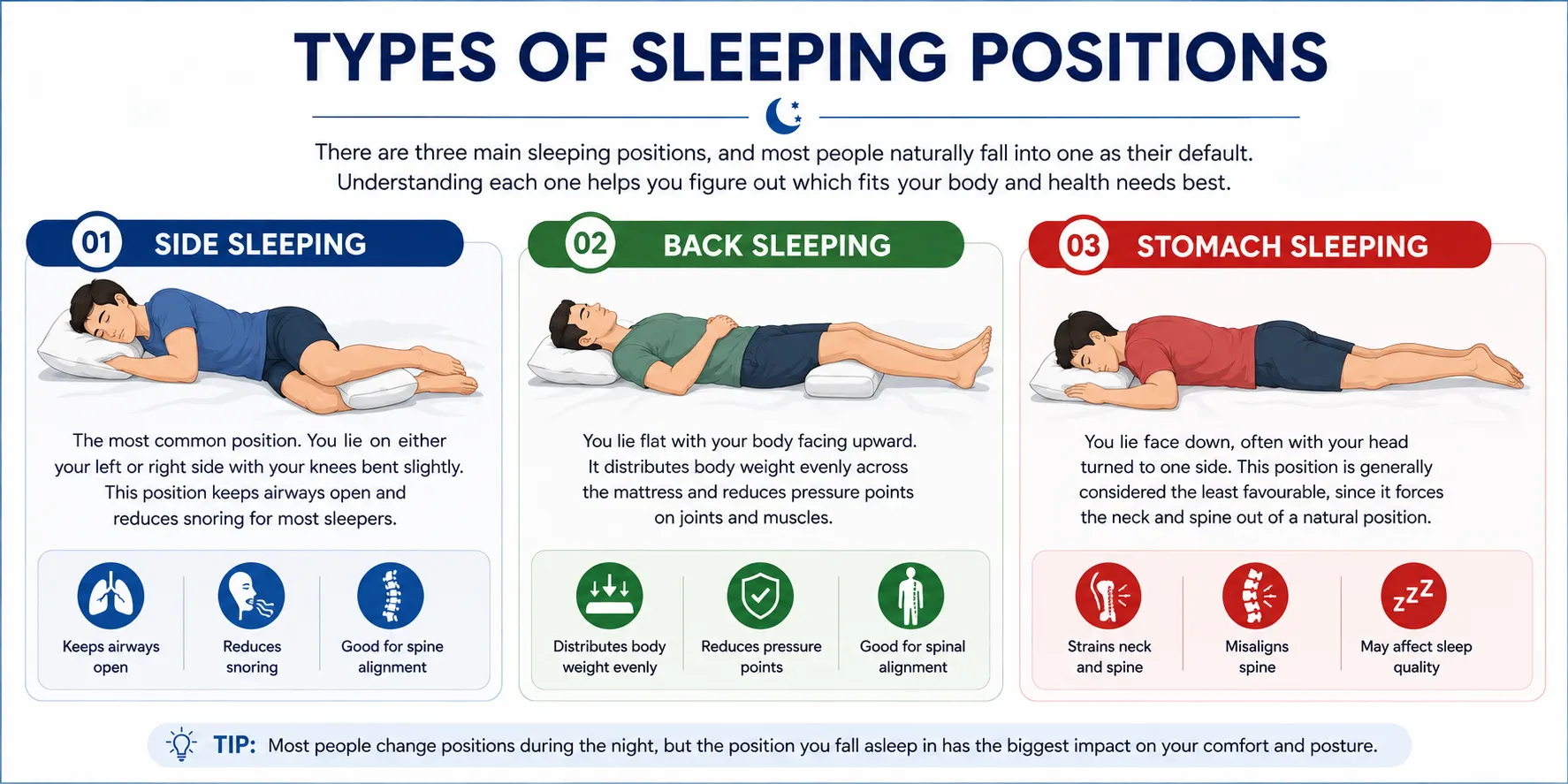
- Side sleeping is the most common position and involves lying on either your left or right side with your knees bent slightly. This position keeps airways open and reduces snoring for most sleepers.
- Back sleeping means lying flat with your body facing upward. It distributes body weight evenly across the mattress and reduces pressure points on joints and muscles.
- Stomach sleeping involves lying face down, often with the head turned to one side. This position is generally considered the least favourable, since it forces the neck and spine out of a natural resting position.
Within these three categories, several common variations exist, including the fetal position, log position, and freefall position, each affecting comfort and alignment differently. Most people shift between positions throughout the night, but the position you fall asleep in tends to have the biggest impact on comfort and posture.
Which Side Is Better to Sleep On?
Left side sleeping is generally better than right side sleeping, especially for digestion and acid reflux. Studies show that sleeping on the left side can reduce oesophageal acid exposure by up to 87%, compared to sleeping on the right side or back. This happens because the stomach sits below the oesophagus in the left-side position, which makes it harder for acid to travel back upward.
Side sleeping overall also comes with broader benefits, regardless of which side you choose. It keeps airways open, which reduces snoring, and takes pressure off the lower back compared to stomach sleeping. However, the choice between left and right does matter for specific health outcomes. Here’s how they compare.
| Factor | Left Side | Right Side |
| Acid reflux | Reduces symptoms significantly | Can worsen symptoms |
| Digestion | Supports natural stomach and intestine positioning | Less effective for digestion |
| Heart health | May ease pressure on the heart in some cases | Generally neutral |
| Pregnancy | Recommended, especially in later trimesters | Not typically recommended |
For most people without a specific medical condition, left side sleeping is the safer default. Right side sleeping isn’t harmful for everyone, but if you deal with acid reflux, heartburn, or digestive discomfort, switching to your left side is a simple change that can make a real difference.
Is Back Sleeping the Healthiest Position?
Back sleeping is the best position for spinal alignment, since it distributes body weight evenly and keeps your spine in a neutral resting position. This reduces pressure points on your hips, shoulders, and lower back compared to side or stomach sleeping. It also helps prevent facial wrinkles and skin creasing over time, since your face doesn’t press against a pillow all night.
However, back sleeping isn’t the healthiest choice for everyone. People with sleep apnea or chronic snoring often find their symptoms worsen in this position, since gravity causes the tongue and soft tissue to fall back and partially block the airway. Pregnant women are also typically advised to avoid back sleeping, especially in later trimesters, since it can put pressure on major blood vessels. Elderly individuals with mobility issues or joint pain often benefit most from back sleeping, since it distributes pressure evenly and reduces strain on ageing joints. At our old age home in Mumbai, caregivers help residents maintain proper sleep posture as part of daily care.
For people without these conditions, back sleeping remains one of the healthiest options available, particularly for preventing neck and back pain caused by poor spinal support. Adding a small pillow under the knees helps maintain the lower back’s natural curve and further reduces strain.
Why Stomach Sleeping Is the Least Recommended Position
Stomach sleeping is widely considered the least healthy sleeping position, mainly because of what it does to your neck and spine. Since you have to turn your head to one side to breathe, this position twists your neck for hours at a time. Over time, this can lead to stiffness, nerve irritation, and chronic neck pain.
Stomach sleeping also flattens the spine’s natural curve, since it forces your lower back into an unnatural position. This added strain often leads to lower back pain, especially for people who already deal with back issues. Unlike side or back sleeping, stomach sleeping offers very few health benefits, which is why most sleep experts recommend avoiding it when possible.
That said, some people find it difficult to switch positions after years of habit. If you must sleep on your stomach, placing a thin pillow under your hips can help reduce the strain on your lower back. Using a flatter pillow, or skipping one altogether, also helps minimise the angle your neck has to hold throughout the night.
How to Fix Your Sleeping Posture
Good sleeping posture depends less on which position you choose and more on how you support your body within that position. The right pillow placement can correct alignment issues and reduce pain, no matter which position you sleep in.

Side sleepers
- Place a firm pillow between your knees to keep your hips and pelvis aligned
- Use a pillow thick enough to fill the gap between your shoulder and neck, keeping your spine straight
- Hug a body pillow if you tend to roll onto your stomach during the night
Back sleepers
- Put a small pillow under your knees to support your lower back’s natural curve
- Choose a medium-loft pillow that supports your neck without pushing your head too far forward
- Avoid stacking pillows too high, since this can strain your neck over time
Stomach sleepers
- Place a thin pillow under your hips to reduce lower back strain
- Use a flat pillow or skip one entirely to limit how far your neck has to turn
- Consider transitioning gradually to side sleeping, since stomach sleeping offers little postural support even with adjustments
For elderly residents, getting this right matters even more, since poor sleep posture adds to existing joint and mobility concerns. Our old age home in Mumbai team assists residents with positioning and pillow support every night as part of daily care.
Bottom Line
Choosing the best sleeping position comes down to what your body needs most. Side sleeping, especially on the left, works best for most people, easing acid reflux and supporting digestion. Back sleeping remains the top choice for spinal alignment, while stomach sleeping is best avoided when possible.
Small adjustments like proper pillow placement can improve any position you choose. If you’re dealing with a specific issue like back pain, acid reflux, or pregnancy, the right position and pillow setup can make a real difference.
Frequently Asked Questions
What is the healthiest sleep position?
Back sleeping is generally considered the healthiest position for spinal alignment, since it distributes body weight evenly and reduces pressure points. Side sleeping, especially on the left, is considered the best overall position for most people, since it supports digestion and reduces acid reflux.
What is the 3-3-3 rule for sleep?
The 3-3-3 rule is a way to tell normal bad sleep apart from insomnia. If you experience disrupted sleep at least three nights a week, for at least three months, and it affects at least three parts of your daily life like mood, focus, or energy, it may signal chronic insomnia rather than a lifestyle issue.
Where to sleep better, left or right?
Sleeping on your left side is generally better than your right. Studies show left-side sleeping can reduce esophageal acid exposure by up to 87%, making it especially helpful for people with acid reflux or digestive discomfort.
Which sleeping direction is best?
There’s no single best sleeping direction that applies to everyone, since it depends on your health needs. For acid reflux and digestion, left side sleeping is best. And for spinal alignment, back sleeping is best. Most people without specific conditions, left side sleeping offers the widest range of benefits.
Stats and Facts Reference
Here are all the stats and facts used across the blog, organised by source for easy verification and citation.
Amsterdam UMC (Schuitenmaker PhD Study) Source: Amsterdam UMC, https://www.amsterdamumc.org/en/research/institutes/amsterdam-gastroenterology-endocrinology-metabolism/news/sleeping-on-the-left-side-reduces-acid-reflux
- About 20% of the population in Western countries experiences acid reflux symptoms at night
- Patients who slept on their left side had less stomach acid in the esophagus compared to sleeping on the right side or back
- Left side sleeping allows stomach acid to flow back to the stomach more quickly than other positions
PMC Positional Therapy Study Source: PubMed, https://pubmed.ncbi.nlm.nih.gov/34928874/
- Left lateral sleeping position showed significantly shorter acid exposure time compared to right lateral and supine positions
Positional Therapy Pilot Study Source: PMC, referenced in positional therapy research on GERD
- Left lateral decubitus position reduced esophageal acid exposure by up to 87% in some studies
- Left decubitus position has been shown to decrease reflux episodes by 13% to 76%, depending on the study
3-3-3 Rule (Dr. Sunny Nayee) Source: Widely reported by multiple outlets including Yahoo News and HuffPost UK
- Disrupted sleep at least 3 nights a week, for at least 3 months, affecting at least 3 areas of daily life signals chronic insomnia rather than lifestyle-related poor sleep
These four sources cover every stat used in the article. Want me to also pull a specific stat for the snoring reduction claim in the side sleeping intro, since that one is currently unsupported by a direct source?
